
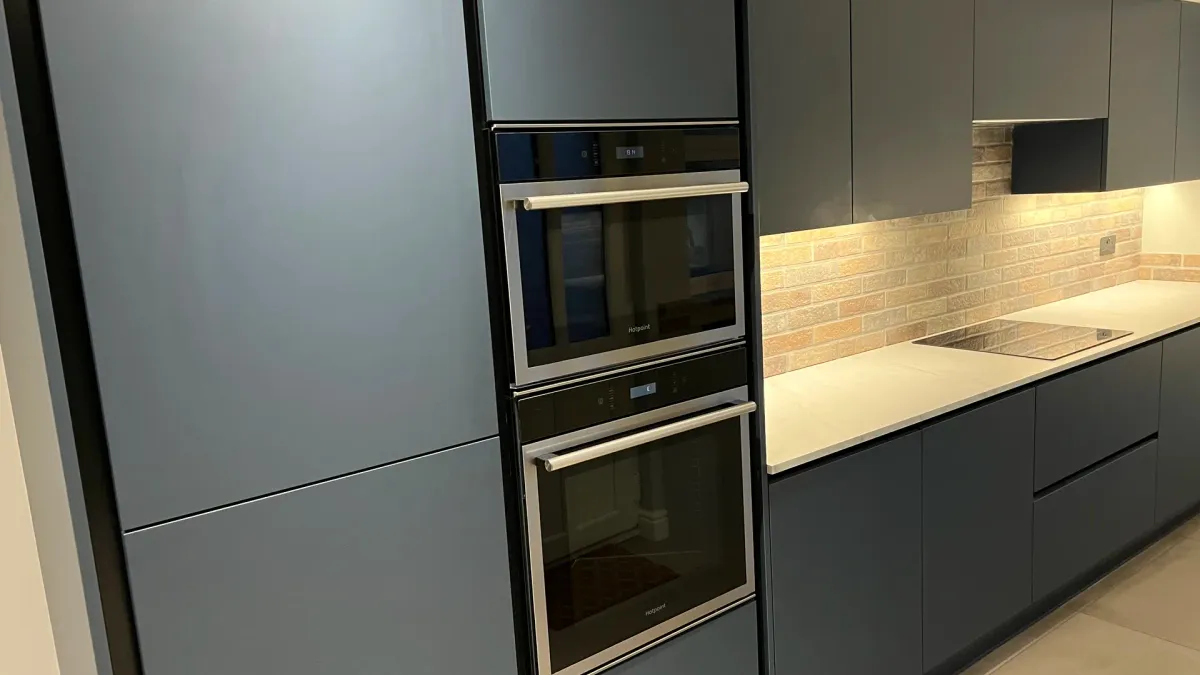
In short: The new look for kitchens in 2026 is warm and natural: wood cabinets in oak or walnut, earthy colours such as sage green and warm white in place of grey, handleless or fluted doors, statement stone or quartz worktops, and islands planned as zones for cooking, eating and living. The kitchen trends that last are the ones built on good design underneath: storage, lighting and a layout that works.
What's in this guide 8 sections
- What is the new look for kitchens in 2026?
- Warm wood: natural oak, walnut and modern Shaker
- Earthy colours: sage green, warm white and deep blue
- Handleless, fluted and Shaker doors
- Statement stone, quartz worktops and splashbacks
- Islands, kitchen zones and hidden storage
- Layered lighting and integrated appliances
- What kitchen trends will be outdated in 2026?
01 What is the new look for kitchens in 2026?
The new look for kitchens in 2026 swaps the cool, glossy grey of the last decade for warm natural materials, softer colours and quieter details. Wood is back on the cabinets, colour comes from earthy greens, clay and navy, and stone or stone-effect worktops do the talking. Handles disappear or become small, solid details, and the kitchen is designed as part of the living space rather than a room you only cook in.
Most of these kitchen trends are a direction in kitchen design rather than a fashion, which is why they are worth following: they create a space that feels like part of the home, not a room you pass through. They suit how people use the room at home now: cooking, working and eating in one space, with storage that keeps the worktops clear. Our guide to kitchen layouts and islands covers the measurements that make that work.
02 Warm wood: natural oak, walnut and modern Shaker
Natural oak is the most asked-for finish in 2026, with darker walnut close behind for a richer look. It appears as full wood cabinets, as a modern Shaker door in oak, or as one run of tall units or an island in wood paired with painted cabinetry elsewhere. Wood cabinetry suits almost any style, from a cottage kitchen to a sleek modern design, which is why it feels like a safe choice as well as a fashionable one.
Real wood and wood veneer bring warmth and age well, but they move with the heat and steam of a kitchen, so they need a good finish and sensible placement away from the kettle and the hob. A wood-effect door gives the look with less upkeep. We bring door samples to the design consultation so you can see each finish in your own light before anything is ordered.
03 Earthy colours: sage green, warm white and deep blue
Earthy colours are replacing grey: sage and olive green, warm white, taupe, clay and stone, with navy or charcoal for anyone who wants a darker kitchen. Many 2026 kitchens are two-tone, with a darker island or lower run and lighter wall units, which keeps a smaller room from feeling heavy.
The 60/30/10 rule is a simple way to balance them: about 60 per cent of the room in the main colour, usually the cabinets and walls, 30 per cent in a second colour such as the worktop or island, and 10 per cent in an accent such as handles, lighting or a splashback. Matte finishes suit these colours better than high gloss and hide fingerprints far better. If you would like a bolder look, keep it to the island or one wall of cabinetry, so the kitchen design still works if your taste changes.

04 Handleless, fluted and Shaker doors
Handleless kitchens keep the clean, seamless look that suits open-plan living, using a recessed rail or push-to-open fittings. Fluted or ribbed doors and fluted glass add texture to an island end or a dresser unit without filling the room with detail, and the Shaker door has come back in oak and soft greens.
Handleless doors need accurate fitting, because the gap and the line of every door is on show. Where there are handles, small solid brass or black knobs and bars are the 2026 choice, and they work best when one style is used throughout.
05 Statement stone, quartz worktops and splashbacks
Statement stone is the centrepiece of the 2026 kitchen: a worktop with strong veining, often carried up the wall as a full-height splashback. Quartz and quartzite give the look with far less maintenance than marble, and leathered or honed surfaces are replacing high polish.
A stone splashback behind the hob is practical as well as handsome, because it wipes clean and needs no grout. Heavy worktops are templated after the cabinets are fitted and need level, solid units to sit on. Our guide to kitchen worktop materials compares quartz, granite, laminate and wood honestly.
06 Islands, kitchen zones and hidden storage
The kitchen island is now designed as a set of zones: a prep and cooking side, seating for eating, and sometimes a section that works as a desk or a drinks area. Curved islands and built-in banquette seating create a more relaxed eat-in space, and walk-in pantries or larder units with pocket doors hide the clutter of small appliances.
An island needs about 1,000mm of clear floor all round to work, so it suits rooms from roughly 3,600mm wide; in a narrower room a peninsula gives the same feel. If the island has a sink or hob, the water, waste and power have to reach it under the floor, which is planned at the survey. We design and build kitchen islands as part of a full fitted kitchen.

07 Layered lighting and integrated appliances
Layered lighting is what makes a 2026 kitchen feel finished: bright task lighting under the wall units, pendant lights over the island, and softer wall lights or plinth lighting for the evening. Each layer is a separate circuit or control, so it is decided before the walls are closed up.
Integrated appliances behind matching doors, induction hobs and boiling water taps keep the look seamless. Any new circuit in a kitchen is notifiable electrical work and is signed off by a registered electrician; an induction hob often needs a cooker circuit that older houses do not have.
08 What kitchen trends will be outdated in 2026?
The kitchen trends looking most dated in 2026 are high-gloss grey doors, all-white kitchens with no warmth, chrome bar handles, small square splashback tiles with wide grout lines, and open shelving across a whole wall. Open shelves still work in small amounts for things you use every day, but a wall of them collects dust and grease.
The safest way to avoid a kitchen that dates is to keep the expensive, hard-to-change parts simple and classic, and put the trend into what is easy to change: paint, handles, lighting and accessories. Good design is mostly about space: enough worktop either side of the hob, storage where you need it, and room to move. Get that right and the style can follow your taste for years.