
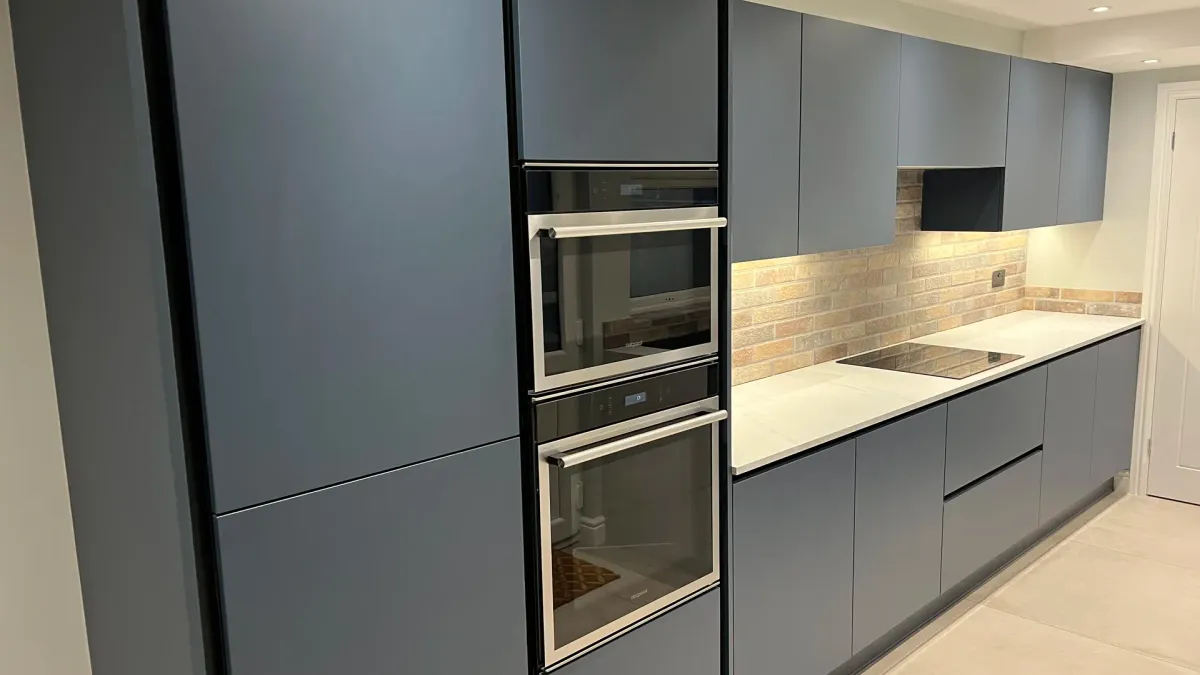
In short: There is no best worktop material, only the right one for how a household actually cooks. Quartz is the most practical all-rounder and resists almost everything except direct heat. Granite handles heat but needs sealing. Porcelain resists everything but chips at the edges. Solid wood is the warmest and the highest maintenance. Laminate is far better than its reputation and is the only material with no lead time.
What's in this guide 5 sections
01 The six materials, compared
Every worktop is a trade-off between four things: heat resistance, scratch resistance, stain resistance and how visible the joints are. Nothing wins on all four.
| Material | Heat | Scratches | Stains | Joints | Upkeep |
|---|---|---|---|---|---|
| Laminate | Poor — will scorch | Good | Very good | Visible | None |
| Solid wood | Poor — will mark | Poor, but sandable | Poor without oil | Nearly invisible | Re-oil 2–3× a year |
| Quartz | Poor — can scorch and discolour | Excellent | Excellent | Slightly visible | None |
| Granite | Excellent | Excellent | Good, needs sealing | Visible | Reseal every 1–2 years |
| Porcelain / sintered stone | Excellent | Excellent | Excellent | Slightly visible | None |
| Solid surface (acrylic) | Poor | Moderate, but repairable | Very good | Invisible | None |
The heat column catches people out. Quartz is roughly 90% ground stone bound in a polymer resin, and it is the resin that fails — a pan straight off the hob leaves a permanent white scorch that cannot be polished out. It is the single most common way an expensive worktop gets ruined.
02 Which worktop suits which household?
- You cook seriously, every day, with hot pans and sharp knives — granite or porcelain. They are the only two materials that shrug off both heat and blades.
- You want it to look immaculate for fifteen years with no maintenance — quartz, and buy a trivet. It is the most forgiving surface in normal use by a wide margin.
- You want a warm, characterful kitchen and do not mind maintaining it — solid wood. Accept that it will mark, and that those marks are the point.
- You want an unbroken run with no visible seam, or a curved or moulded shape — solid surface. It is the only material that joins genuinely invisibly and can be thermoformed.
- The budget is tight and you would rather put the money into better units — laminate. Modern laminates with a square edge look far better than the postformed rolled edge people remember, and they fit the same week.
- It is a rental or a flip — laminate. It is durable enough, it is replaceable, and stone in a rental is money you do not get back.
03 How much longer do stone worktops take?
Stone, quartz and porcelain worktops are templated after the units are installed and levelled, then cut off site. That takes 10 to 14 days at most fabricators, so a kitchen with stone tops runs to about three weeks in calendar time even though the working days are unchanged.
Laminate and solid wood are cut on site by the fitter and add nothing to the programme. Solid surface is fabricated off site like stone but is sometimes quicker, at 7 to 10 days.
A fabricator cannot template from a plan. It has to be taken from your actual installed units, because a wall that runs 15mm out over three metres has to be scribed to, and no drawing will tell them that.

04 Thickness, edges and upstands
Worktop thickness is mostly a look rather than a strength question. Stone and quartz come in 20mm and 30mm as standard, with 12mm and 20mm slim profiles available and mitred edges used to make a 20mm slab appear 60mm or 100mm thick. Laminate is usually 38mm or 22mm; solid wood typically 27mm or 40mm.
The detail that matters more than thickness is what happens where the worktop meets the wall. An upstand — a 100mm strip of the same material — is easier to keep clean than a tiled joint and does not crack when the worktop moves. A full-height splashback in the same material behind the hob is the most wipeable surface you can have, and it is the one place it is worth the money.
05 What people get wrong
- Putting a hot pan on quartz. Permanent, unrepairable, and the most common damage we see on kitchens under two years old.
- Choosing a very dark matt quartz. It shows every water mark and fingerprint in a way the showroom lighting will not reveal.
- Undermounting a sink into laminate. The exposed chipboard core swells the first time it gets wet, and no sealant lasts. Undermount into stone, quartz, porcelain or solid surface only.
- Solid wood around a sink without a proper end-grain seal. Wood swells and blackens where water sits, and around a sink it always sits.
- Specifying a worktop before the units. The units set the template, so a worktop ordered early cannot be right.
- Choosing from a 100mm sample. Ask for the largest sample the supplier has, and look at it in the actual room, at night, under the lights you will actually use.