
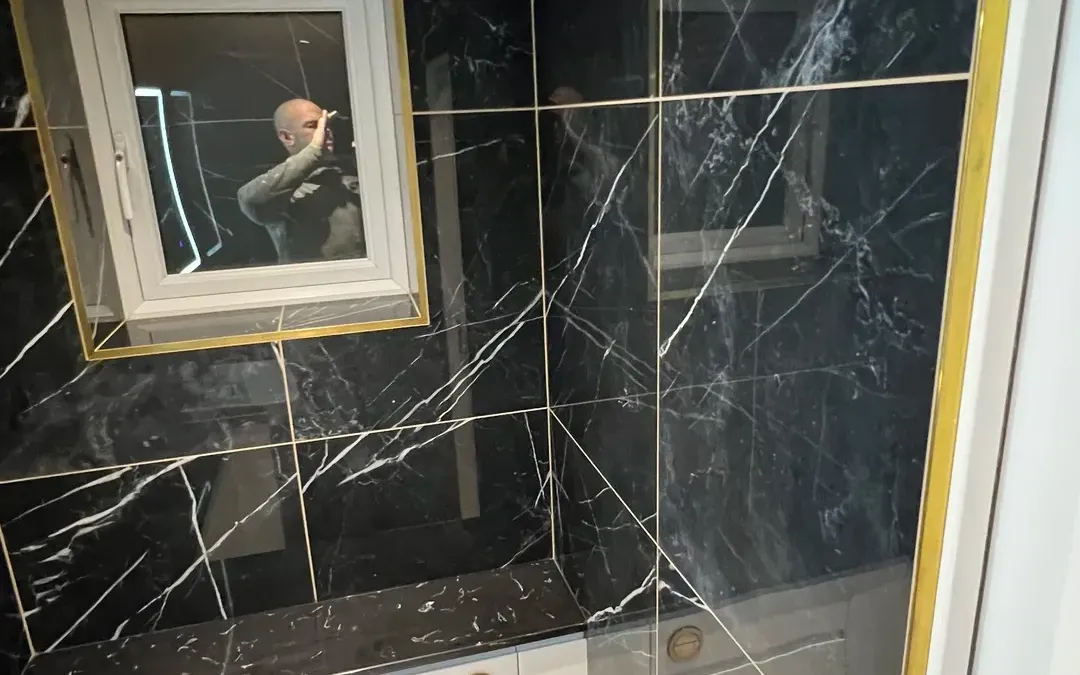
In short: The bathroom design trends for 2026 are walk-in showers and wet rooms, warm and soft colours in place of grey, natural textures such as wood and stone-effect finishes, large-format tiles, wall-hung furniture, mixed or brushed metal brassware, and layered lighting with lit mirrors. Most of them look simple and need more care behind the scenes: flatter walls, stronger fixings, tanking and better ventilation. That is the part that decides whether a trend still looks good in ten years.
What's in this guide 11 sections
- What are the trends in bathroom design for 2026?
- Walk-in showers and wet rooms
- Warm colours, soft neutrals and colour drenching
- Natural textures: wood, stone and texture in the tiles
- Large-format tiles and fewer grout lines
- Wall-hung furniture, floating vanities and curved shapes
- Brassware, lighting and smart features
- What is the golden rule for bathroom layouts?
- What bathroom tile never goes out of style?
- What are some outdated bathroom trends to avoid?
- How do you follow a trend without regretting it?
01 What are the trends in bathroom design for 2026?
The main bathroom design trends for 2026 are a move towards spa-like, calm rooms that feel like a retreat from everyday life: walk-in showers instead of a shower over the bath, warmer colours and natural textures instead of cool grey, fewer and larger tiles, furniture lifted off the floor, softer curved shapes, and lighting planned in layers. A freestanding bath stays popular where the room is big enough to give it space on all sides; in a smaller room, a fitted bath with a tiled panel gives a similar luxury feel.
None of these are new ideas, which is good news. They are the direction bathrooms have been heading for several years, and they suit how people use the room now: a quick shower on a weekday, somewhere to unwind at the weekend, and storage that keeps the surfaces clear. What changes in 2026 is mostly the finish: warmer, more textured and less clinical, with natural materials that bring character to a modern bathroom and help create a sense of space.
02 Walk-in showers and wet rooms
Walk-in showers are the trend with the most practical sense behind it. A low tray, or a fully tiled wet room floor, with a single fixed glass screen is easier to clean than a curtain or a framed enclosure, and level or near-level access suits everyone in the house as they get older.
What it needs is a floor that falls to the drain and a room that is properly waterproofed. In a wet room, the whole floor and the lower walls are tanked before tiling, and upstairs the joists are checked first, because forming a fall over a timber floor is a structural question as well as a tiling one. Our guide to walk-in showers versus wet rooms explains the difference and the cost.
03 Warm colours, soft neutrals and colour drenching
Grey is giving way to warm neutrals, earthy tones, soft greens and muted blues, and some bathrooms take one colour across the walls, ceiling and woodwork, which designers call colour drenching. Warm white, stone, clay and sage are easy to live with; deep greens, navy and terracotta work best as one wall or a vanity unit rather than every surface.
Paint in a bathroom has to cope with steam, so it should be a bathroom-grade emulsion over properly prepared plaster, and the room needs an extractor that genuinely clears it. A colour that looks warm in a showroom can look very different under a north-facing window, so try a sample on the wall first.

04 Natural textures: wood, stone and texture in the tiles
Natural textures are the biggest finish trend for 2026: wood-effect vanity units and shelving, stone-effect and marble-effect porcelain, fluted or ribbed fronts, and tiles with a handmade or uneven glaze. They bring warmth to a room that is otherwise all hard, shiny surfaces.
Porcelain that looks like stone or wood gives the look without the upkeep of the real thing. Real timber needs to be sealed and kept out of the shower zone, and real stone needs sealing and more care with adhesive and grout. Our guide to the best bathroom flooring compares the practical options.
05 Large-format tiles and fewer grout lines
Large-format tiles, 600mm × 1200mm and bigger, give a calmer, more seamless look with far fewer grout lines to clean. They are the main reason modern bathrooms look so uncluttered.
They are also the trend that most depends on the work underneath. A large, flat tile shows every bump in the wall behind it, so the walls must be flat, often re-boarded, and the tiles are heavy enough to need two people and the right adhesive. Mosaics are the opposite: small tiles that suit curved walls, shower niches and a shower floor that has to fall to a drain.
06 Wall-hung furniture, floating vanities and curved shapes
Wall-hung basins, vanity units and toilets lift everything off the floor, which makes a small room feel bigger and makes the floor easy to clean. Curved vanities, round mirrors and softly rounded baths and basins are replacing the hard-edged shapes of the last decade.
A wall-hung toilet or basin needs a frame or a solid wall to hang from, and the cistern is usually hidden behind a boxed-in panel with an access plate. In older houses with stud walls, that frame is planned in at the survey, because it decides where the waste and the supply can run.

07 Brassware, lighting and smart features
Brushed brass, brushed nickel, gunmetal and matt black are still the finishes people choose for taps, showers and towel rails, and mixing two metals in one room is now common. Thermostatic showers, concealed valves and fixed rainfall heads with a separate handset are the usual specification.
Lighting is planned in layers: a main light, lit or LED mirrors at the basin, and sometimes a low-level light in a niche or under a floating vanity. Every one of those has to be wired to suit the bathroom zones under Part P, so it is decided at first fix, not after the tiles are up. Heated towel rails and underfloor heating are the comfort upgrades most worth planning in at the same stage.
08 What is the golden rule for bathroom layouts?
The golden rule is to leave enough clear space in front of each fitting to use it comfortably, and to plan the layout around the waste pipes rather than fighting them. In practice that means around 600mm to 700mm of clear floor in front of a toilet and basin, a door that does not hit anything as it opens, and the toilet placed where its waste can reach the soil stack with a proper fall. Our guide to small bathroom ideas works through layouts for the rooms most houses actually have.
09 What bathroom tile never goes out of style?
A plain white or warm off-white ceramic tile, laid simply, is the bathroom tile that never goes out of style, whether it is a metro brick, a large square or a classic format. Neutral stone-effect porcelain comes close. Trends date the bold patterns and colours fastest, so if you want those, put them where they are easy to change: a single feature wall, a vanity unit or the paint, rather than the whole floor.

10 What are some outdated bathroom trends to avoid?
The outdated bathroom trends to avoid are the looks most likely to date a bathroom quickly, or to cause problems later:
- All-grey bathrooms with cool white lighting, which are giving way to warmer colours.
- Thin border tiles and busy mosaic strips run around the whole room.
- Glossy black tiles and fittings that show every water mark and limescale spot.
- Tiling on top of old tiles or old plaster to save time, which is a shortcut that fails, not a trend.
- Shower curtains over a bath in a family bathroom where a walk-in shower or a fixed screen would fit.
- Vessel basins without enough worktop around them, which splash and are awkward to clean.
11 How do you follow a trend without regretting it?
Spend on the parts that are hard to change, and follow trends in the parts that are easy to change. The waterproofing, the floor, the pipework, the ventilation and a good shower valve sit behind the tiles for twenty years. The paint colour, the towel rail finish, the mirror and the accessories can be swapped in an afternoon.
Barbers Bathrooms & Kitchens designs each bathroom with you at the survey, in the room itself, so a trend is judged against your walls, your light and your waste route before anything is ordered. See our bathroom installation service for how a full installation runs.
Sources and references
- Electrical safety: Approved Document P — GOV.UK . Checked 28 October 2026
- Ventilation: Approved Document F — GOV.UK . Checked 28 October 2026