
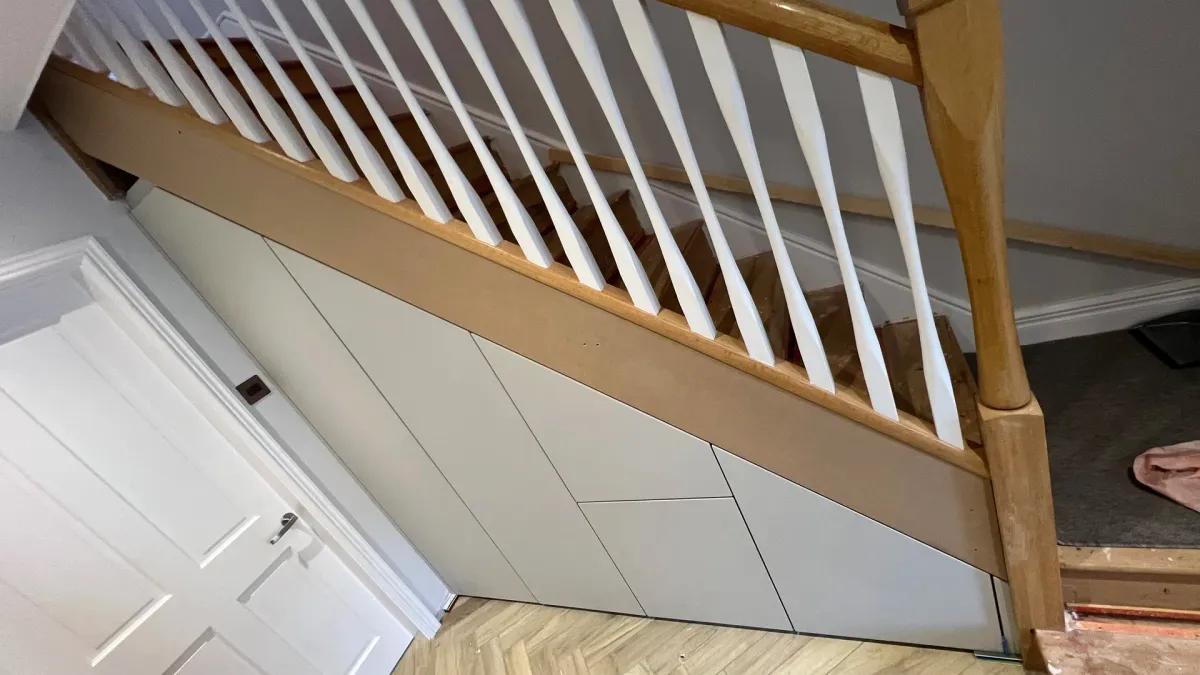
In short: A fitted wardrobe is built into the room and uses its full height and depth, including the awkward space around chimney breasts and under sloping ceilings. It typically yields 20 to 30% more usable storage than freestanding furniture in the same footprint, and it stays with the house when you move. Freestanding wins in rented homes, in rooms you expect to reconfigure, and where the walls are too irregular to justify the scribing work.
What's in this guide 6 sections
01 What is a fitted wardrobe?
A fitted wardrobe is defined as storage built and installed in position, scribed to the walls, floor and ceiling of the specific room, so that it becomes part of the structure rather than furniture standing in front of it. It has no sides or back of its own where the walls do the job, and no gap above, below or behind.
That is the whole difference, and it is where the extra capacity comes from. A freestanding wardrobe is a box with its own four sides, and it has to be small enough to get up your stairs and through your door. A fitted wardrobe is built to the room and can be 2,600mm tall in a room with a 2,600mm ceiling.
02 Fitted vs freestanding: the differences that matter
| Fitted | Freestanding | |
|---|---|---|
| Usable storage per m² of floor | Highest — full height and depth | 20–30% lower |
| Awkward spaces (chimney breast, eaves) | Used | Wasted |
| Dust gap above and behind | None | Always |
| Moves house with you | No | Yes |
| Reconfigurable later | No | Yes |
| Install time | 2–5 days on site | An afternoon |
| Relative cost | Higher | Lower |
| Effect on a room’s proportions | Reads as architecture | Reads as furniture |
03 Where does the extra storage actually come from?
Three places, and it is worth knowing which of them apply to your room before deciding.
- Height. A freestanding wardrobe is typically 1,800mm to 2,100mm tall because it has to be manoeuvrable. In a room with a 2,400mm ceiling, that leaves 300mm to 600mm of dead space above it collecting dust. A fitted run takes that space as a top box, which is where the suitcases and the Christmas decorations go.
- The gaps. A freestanding unit needs clearance to slide into place and leaves 20mm to 50mm down each side and behind. Across a four-metre wall with three units, that is most of a fourth unit’s worth of space lost to gaps.
- The awkward bits. Chimney breast alcoves, sloping ceilings in a loft conversion, the run over a stair bulkhead. Freestanding furniture cannot use any of it. Fitted joinery is the only thing that can, and in a 1930s bedroom with two alcoves either side of a chimney breast, that is often half the storage in the room.

04 When freestanding is the right answer
Fitted is not automatically better, and we will say so at the survey rather than sell you something you should not buy.
- You are renting, or you expect to move within two or three years. Fitted joinery is a gift to the next owner, not an asset you take with you.
- The room’s use is not settled — a nursery that will become a study, a spare room that might become a bedroom.
- You want the flexibility to change the layout of the room later. A fitted run fixes the geometry of a bedroom permanently.
- The room is very small and a fitted run on the only usable wall would make it feel like a corridor. Sometimes the honest answer is a smaller wardrobe.
05 What actually drives the price of fitted wardrobes
Not the width, which is what most people assume. A four-metre run of hanging rail and shelving is not far off the cost of a three-metre run. The money is in what happens inside and how the doors work.
- Drawers. Every drawer is a box with runners and a front, and it costs several times what an equivalent shelf costs.
- Sliding doors. A good sliding gear system is a significant cost over hinged doors, and it also loses you around 100mm of internal depth to the track.
- Internal fit-out. Pull-out rails, shoe racks, tie racks, jewellery drawers and integrated lighting all add up quickly.
- Finish. A hand-painted or sprayed finish costs meaningfully more than a factory-finished board, and a hardwood veneer more again.
- The room. A room that is out of square, has a sloping ceiling, or has skirting and coving to scribe around takes longer to fit, and that is labour on site.
If the budget is tight, the honest advice is to spend it on the carcass, the doors and the scribing, and keep the interior simple. Hanging rails and adjustable shelves in a well-built, well-fitted run will serve you better than drawers in a poorly scribed one.
06 Do fitted wardrobes add value to a house?
They rarely add a specific, quantifiable amount to a valuation, but well-made fitted storage consistently helps a house sell, particularly in period properties where buyers can see that the awkward spaces have been solved. Estate agents in this area will tell you the same thing: a bedroom that photographs as a clean, uncluttered room with concealed storage shows better than the same room with three mismatched wardrobes in it.
Badly made fitted wardrobes do the opposite. Melamine doors that have started to sag, or a run built tight to a damp external wall with no ventilation behind it, are a liability a surveyor will notice. This is a category where the quality of the work is the whole of the value.
